← Back to
Seminars
Enabling Scalable, Hybrid Simulations of Cellular Systems
Eran Agmon, University of Connecticut Health Compositional Systems Biology with Vivarium
Abstract
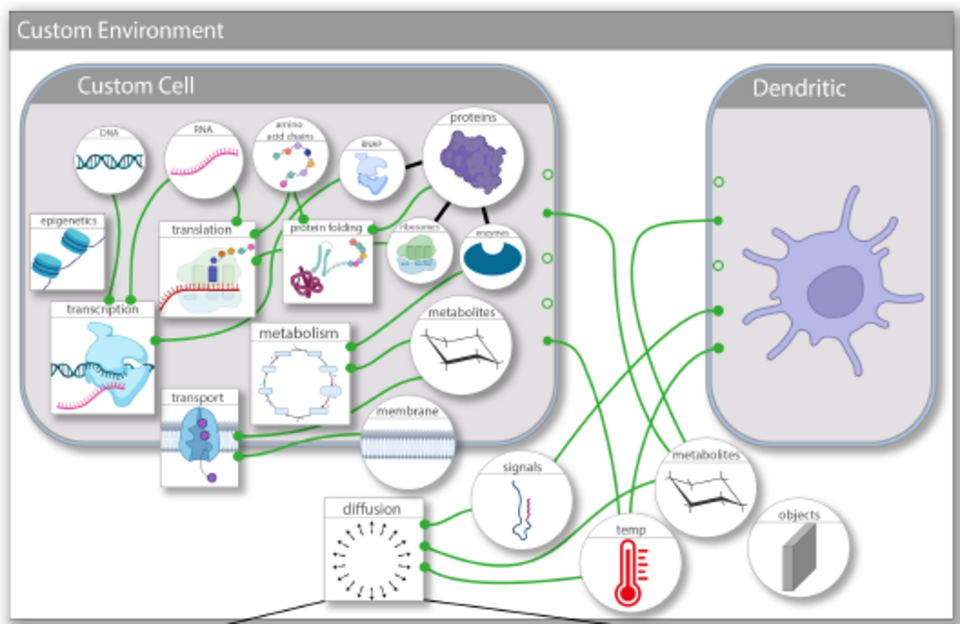
Eran Agmon, University of Connecticut Health Compositional Systems Biology with Vivarium: Enabling Scalable, Hybrid Simulations of Cellular Systems As biomedical models grow in complexity, the need for modular, extensible frameworks becomes increasingly important. This talk introduces Compositional Systems Biology, a domain of systems biology focused on building multiscale biological simulations through modular, interoperable processes. Central to this approach is Vivarium, an open-source software for integrating diverse modeling formalisms—including ODEs, stochastic kinetics, constraint-based models, agent-based systems, and rule-based logic—into unified, hybrid simulations. A flagship demonstration of Vivarium’s capabilities is the implementation of a whole-cell model of Escherichia coli, which integrates over a dozen mechanistic submodels spanning metabolism, gene expression, macromolecular synthesis, and cell division. This model demonstrates Vivarium’s strengths in managing biological complexity through schema-driven composition, modular interfaces, and distributed orchestration. I will discuss design principles behind Vivarium, showcase applications, and preview emerging tools that enable collaborative, scalable, and open-ended systems biology. 1. Agmon, E. (2024). Foundations of a Compositional Systems Biology. ArXiv, arXiv-2408. https://arxiv.org/abs/2408.00942 2. Agmon, E., Spangler, R. K., Skalnik, C. J., Poole, W., Peirce, S. M., Morrison, J. H., & Covert, M. W. (2022). Vivarium: an interface and engine for integrative multiscale modeling in computational biology. Bioinformatics, 38(7), 1972-1979. https://academic.oup.com/bioinformatics/article/38/7/1972/6522109
The presentation slides are available here .